
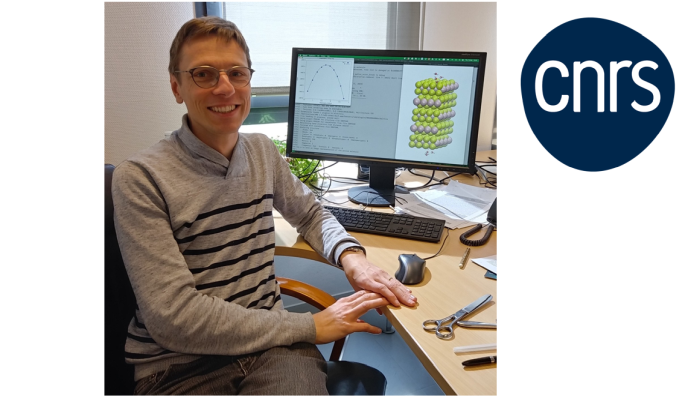
A chemist by training, I have chosen the computational aspects for my PhD work and the following career. Now I am a research scientist working for CNRS, the French agency for fundamental and applied research. My work is hosted at the École Normale Supérieure de Lyon, a research-intensive, university-like, institution. My role in IsoPROPEL is to coordinate the mechanistic investigation of the origin of the deactivation in direct isopropanol fuel cells and to propose catalysts that would be less prone to this deactivation.
What was your original motivation to become a researcher?
Well, I was essentially trained to become a researcher… And so, it was quite natural that I tried to become one and it so happens that it all worked out. Doing academic fundamental research allows me to combine three aspects that are dear to me: Training the next generation of researchers, intellectual stimulation (how to address pressing topics and how to access new knowledge) and a large liberty to organize the work and choose the topics to work on.
What is your (main) research area today?
The main area I am working on these days is the atomistic simulation of electrified interfaces, mostly related to electrocatalysis. This work is generally carried out in close collaboration with experimental partners, which I find particularly rewarding, as computations and experiments are highly complementary.
What is the main objective of your team in IsoPROPEL?
The main objective is to screen or design electrocatalysts that are at least as active as the currently best electrocatalyst for isopropanol electro-oxidation (PtRu) but using less critical raw materials (less Pt) and not suffering from the observed deactivation over time and in presence of acetone.
What expertise and facilities does your team have to meet those objectives?
My research group has access to large-scale high-performance computing facilities, which are indispensable for the work we are carrying out. In terms of expertise, we have developed and applied atomistic simulation methods to understand electrocatalytic reactions over various materials (from metals to oxides and sulfides) and various reactions (from the hydrogen evolution reaction to biomass oxidation). We believe that the time is right to convert this expertise and understanding into the development of better catalysts, a task that is much harder than understanding why existing materials are (not) working.
Which aspects of your research at IsoPROPEL do you believe are the most innovative and what unique opportunities offer IsoPROPEL to yourself and/or your organisation?
Finding a better catalyst via computations is very difficult and it is, therefore, very rare that it actually works. Hence, succeeding in this challenge would be a big step forward. For me and my group the unique opportunity of IsoPROPEL is to work with excellent researchers across Europe, bringing different skills, mindsets and cultures together. Furthering pan-European collaborations in research is important in itself and having access to experimental experts is priceless for a computational chemist that would like to see ideas turned into devices.
How do you see the future use of the IsoPROPEL results and the impact of IsoPROPEL project in our daily lives?
I would be so happy (and a bit proud) if one day ships on rivers and canals would be powered by isopropanol instead of gasoline. I could even reach my home town (Basel, Switzerland) from my workplace (Lyon, France) using such ships! More seriously, I am convinced that climate change is the biggest threat to the long-term survival of our current civilization and trying to help avoiding CO2 emissions is an endeavor I think worthwhile.