
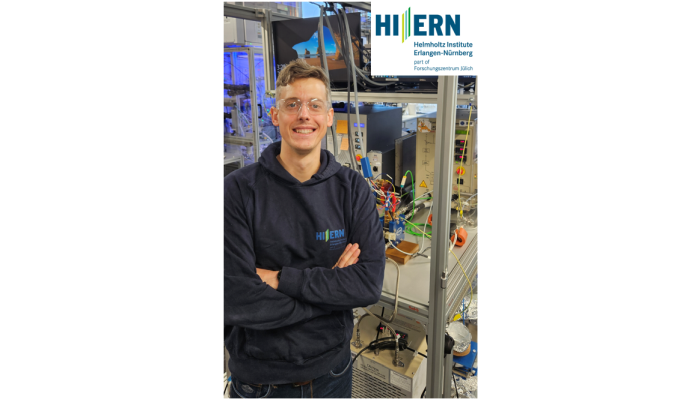
Hi, I am Matthew Brodt, a researcher and team leader at the Helmholtz Institute Erlangen-Nürnberg for Renewable Energy (HI-ERN), which is a part of Forschungszentrum Jülich GmbH, one of the largest research groups in Germany. Our main role in IsoPROPEL is to develop and optimize the Direct Isopropanol Fuel Cell (DIFC). This is the key technology of the project that will enable CO2-free electrification without the difficulties of hydrogen gas handling or capture. Our work will include technical contributions to WP3 and WP4. Specifically, we aim to optimize the fuel cell membrane-electrode assemblies for efficient long-term operation while minimizing the use of PFAS polymers.
What was your original motivation to become a researcher?
I enjoyed science a lot during my studies, particularly chemistry, and I received inspiration from teachers who drew me into research. I realized I enjoy understanding how things work and applying that knowledge to solve issues that have real-world impact. A couple of internships during my bachelor’s degree solidified my desire to conduct research, and I decided to pursue a PhD in Chemical Engineering. In my thesis, I developed a novel design for hydrogen fuel cell electrodes.
What is your (main) research area today?
My team investigates new routes for electrochemical energy storage and conversion, most notably with liquid hydrogen carriers such as the isopropanol-acetone couple. We design new configurations for fuel cells and electrolysis cells, with a focus on optimizing the membrane-electrode assemblies in terms of materials and morphology. We formulate electrode inks, develop coating and assembly procedures, and perform rigorous electrochemical analysis through full-cell testing.
What is the main objective of your team in IsoPROPEL?
Our primary objective is to bring DIFC technology to TRL4 using liquid-fed isopropanol. This requires the identification and incorporation of acetone-resistant ionomers and catalysts. Our demonstrator should average over 50 mA/cm² in a single 25 cm² cell for over 100 hours with an isopropanol feed of 5M or greater. We lead WP3.
What expertise and facilities does your team have to meet those objectives?
Our team at HI-ERN is a DIFC pioneer and a key player in the field of liquid organic hydrogen carriers, possessing strong expertise in electrochemical isopropanol oxidation at both the half-cell and full-cell levels. We have published the highest power densities in a DIFC to date, and we bring significant know-how in electrode ink development and coating from our work with hydrogen fuel cells. We have a complete infrastructure that allows us to transform basic materials, such as new catalysts and polymers, into membrane-electrode assemblies and perform complete electrochemical characterization, including product analysis. Furthermore, we have close collaborators in other teams within HI-ERN who are experts in polymer synthesis for energy applications as well as microscopy.
Which aspects of your research at IsoPROPEL do you believe are the most innovative and what unique opportunities offer IsoPROPEL to yourself and/or your organisation?
Currently, DIFC development is challenging because, unlike most other fuel cell types, the products and reactants are both liquids at low temperatures, leading to transport resistances. Additionally, the best-known isopropanol oxidation catalyst, PtRu, suffers from slow acetone desorption. In the past, these two factors have been partially mitigated by using a vapor-fed cell at the cost of system efficiency. In IsoPROPEL, we want to understand and decouple transport and catalyst effects to redesign a cell that can achieve sustainable high-power densities with a liquid feed. Additionally, we want to push the limits of the hydrogen storage capacity of isopropanol; this means moving to higher concentrations, which are currently limited to about 2M with standard PFSAs like Nafion. Using DIFC for the shipping industry provides a great use case for us to demonstrate the merits of our research and motivates us to push the limits of what is possible.
How do you see the future use of the IsoPROPEL results and the impact of IsoPROPEL project in our daily lives?
IsoPROPEL strives to develop DIFC for the maritime sector, and its success and implementation would be significant. Today, most ships are operated on petroleum-based fuels, which release pollutants into the environment as well as greenhouse gases that contribute to climate change. New alternatives such as methanol and DME, while much cleaner than diesel, still release onboard CO2 emissions. Additionally, in the event of an accident, the long-term damage of an isopropanol spill would be much less severe; oil spills would be a thing of the past.